
When The Sea Won't Answer
Reclaiming agency in unsettled times

Wandering
On a recent trip to Iceland this past spring, we arrived at our small hotel to find it overtaken by a film crew. They were shooting scenes for an upcoming adaptation of The Odyssey.
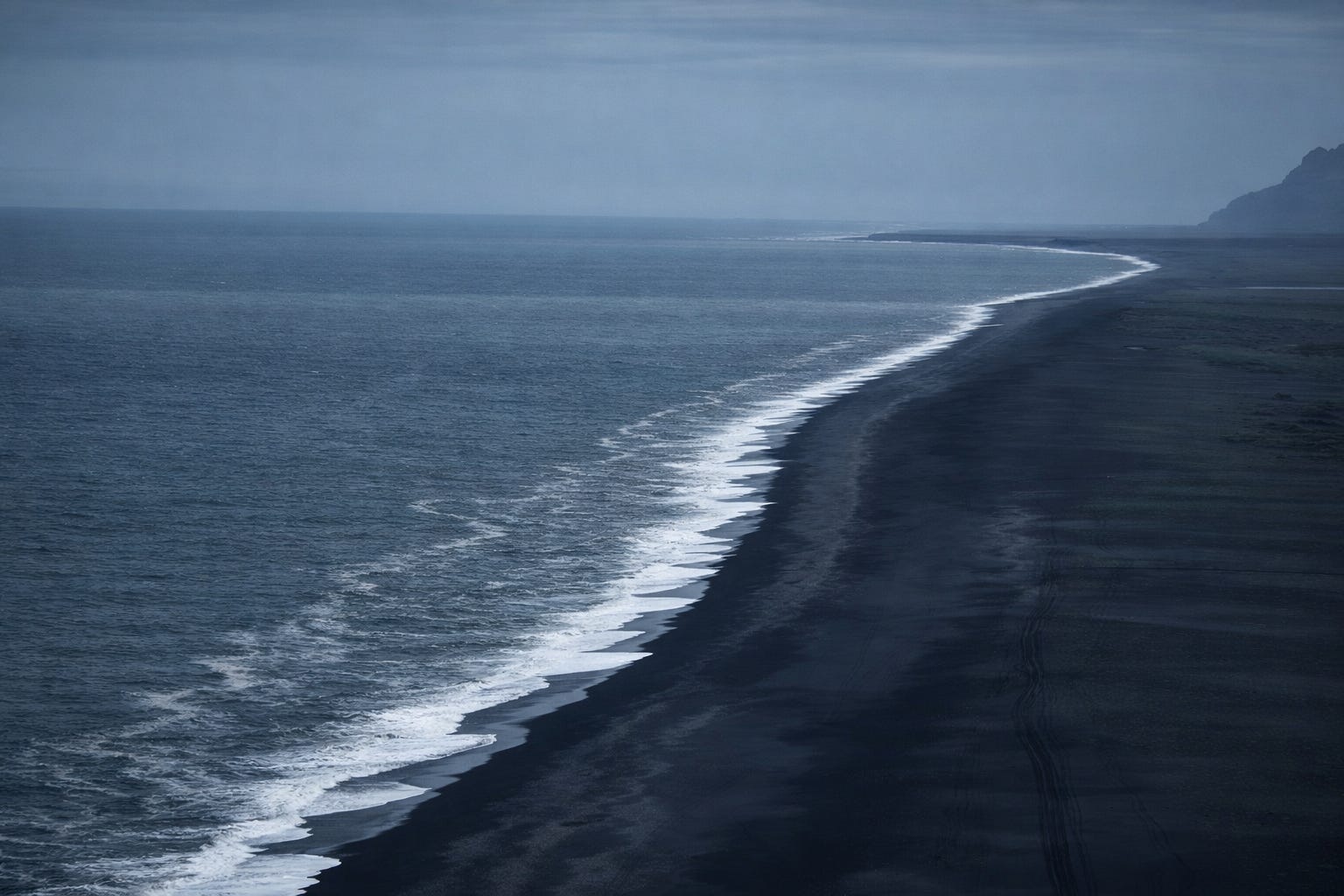
Early the next morning, while birdwatching nearby on a windy promontory overlooking a desolate stretch of black sand beach, I could see the crew far below — actors in costume (they looked frozen) surrounded by cameras and props. I was transfixed. Not only because I secretly hoped they might let me volunteer for the day, but because Homer’s ancient story was being recreated in a primordial landscape. The timeless myth of a man wandering for years, blown off course, trying to find his way home.
Since then, my mind has kept returning to that moment. What is it about this story that resonates across centuries? It speaks to something elemental. To wandering. To long stretches of uncertainty when the horizon is whipped by waves and black skies, when the sea feels filled with temptations and unseen dangers. To being delayed, tested, blown off course, unsure when — or whether — you will arrive. The particulars change with each generation. The feeling does not.
There are times in life when we recognize this wandering. When plans unravel or simply stall. We scan the horizon for reassurance, for signs of arrival, for control. And in that scanning, our attention drifts outward. We begin to live in anticipation rather than action, in fear of what might happen rather than clarity about how we must act now. We rage at the waves.
In those moments, we are no longer on solid ground. We are at sea.
The temptation is to control it — to predict, to manage, to shout at forces that do not answer. But the sea does not respond. What does respond is the rudder. We cannot command the storm, but we can govern our direction within it. Agency begins there.
I’ve felt this wandering more than once — moments when I worried more about outcomes than the work itself. When I anticipated failure, feared how I was perceived, tried to secure what I wanted before I had earned it. In those stretches, attention drifts toward what isn’t ours to govern. We shout at the waves and lose sight of the rudder.
The Stoic Discipline
This distinction is not new. The ancient Stoic philosophers wrestled with the same problem: how to live steadily in a world that refuses to cooperate. They wrote during times of plague, exile, political upheaval, and sudden loss. They understood something easy to forget — much of our suffering comes not from events themselves, but from our insistence on controlling what was never ours to command.
At the center of their teaching was a deceptively simple idea: some things are up to us, and others are not. Our judgments, our choices, our effort — these are ours. Outcomes, reputations, markets, the behavior of others — these are not. Confuse the two, and we exhaust ourselves. Clarify them, and something inside comes into focus.
The Stoics were teaching the art of agency. Not the desire to control the sea, but the discipline of steering within it. When attention returns to what is ours to govern — our judgment, our next action, our alignment with what we value — energy consolidates. The shouting stops. Direction returns.
The work was internal before it was external. The rudder was always inside the boat.
Returning Home
To be at home is not to have arrived. It is to be internally aligned. When what we value, what we choose, and how we act move in the same direction, something solid returns beneath our feet. Indecision eases. The need to constantly monitor how we are perceived loosens its grip. We stop scattering ourselves across imagined futures and instead inhabit the present with intention.
The Helm
We live in a time when much feels unstable — institutions shifting, technologies accelerating, expectations multiplying. The sea is not calm. It may not be for some time.
But the ancient lesson remains unchanged. You cannot still the waves. You can decide how you will travel through them.
Standing on that windswept cliff in Iceland, watching actors recreate a three-thousand-year-old story, I was struck by how little has changed. The details differ. The storms look different. But the human task is the same: not to master the sea, but to return, again and again, to the helm.
You do not have to control arrival to move toward home.
You only have to keep your hands on the helm.
A beautiful piece of writing Rick. You set the bar very high and continue to leap over it. When you wrote that you hoped to join the cast as an extra, I had my fingers crossed. That would have been a once in a lifetime event. I always am impressed by not only what you choose to write, but the way in which you convey your thoughts. Well done yet again.
Thanks Rick for another great post. Really enjoyed this one as it follows the day after seeing Stephen Fry at Shaw where he spent a wonderful couple hours sharing stories. As the writer of Odyssey and Mythos among other tributes to Greek stories and the contributions of the Stoics, he mentioned that a new epic movie is coming out on the Odyssey which you must have been watching. Another insight he shared on the power of these stories is how the Greeks wrote of gods that resonate with us more deeply as they represent more completely human nature and this world which is filled with the "good" like beauty, goodness, and redemption AND the "bad" like narcissism, blind fury, senseless death and jealousy (he said it much more articulately (:). The power of story telling and seeing the lessons within is a talent both you and Stephen seem to share and we all appreciate and benefit from it!